Affiliate Disclosure: Some links in this article are affiliate links. If you purchase through them, IronThaw earns a commission at no extra cost to you. Our rankings are independent — we do not accept payment for placement.

Not long ago, the full recovery protocol — cold plunge, sauna, red light therapy — was a five-figure home gym investment. That's no longer true. In 2026, the budget tier of recovery equipment has gotten legitimately good, not just cheap. You can build a complete budget recovery stack for under $500 that hits the same physiological targets as setups costing ten times more.

This isn't a "good enough for now" compromise guide. It's a real protocol built from components that work, priced for people who want results without a $5,000+ commitment. We'll show you exactly what to buy, what to skip, and how to sequence your purchases if you have to build the stack one piece at a time.

Why Budget Recovery Gear Got Good in 2026

Three things changed. First, LED manufacturing costs for red light panels dropped sharply as diode efficiency improved, meaning a $200 panel today outputs irradiance that would have required a $600 panel in 2022. Second, infrared sauna blanket technology matured — carbon fiber heating elements became commoditized, so the $150–$250 blanket tier now uses essentially the same heating technology as $2,000+ sauna cabins. Third, direct-to-consumer brands cut out the markup that used to pad "premium" recovery products, so a lot of what you were paying for in 2022 was brand tax, not performance.

The honest caveat: budget gear still makes real tradeoffs versus premium tier — smaller coverage areas, no built-in chillers, shorter warranties. The question isn't whether budget gear is "as good" as a $3,000 Plunge tub or a $10,000 infrared cabin. It's whether the budget version delivers enough of the actual physiological stimulus to matter. For all three categories, the answer in 2026 is yes — if you know which specs to check.

The Three Components: What Matters at a Budget Price Point

Before picking products, understand what each component needs to actually deliver a training effect. Spend on these; don't spend on the rest.

Cold Plunge: Temperature Range, Not Chiller Tech

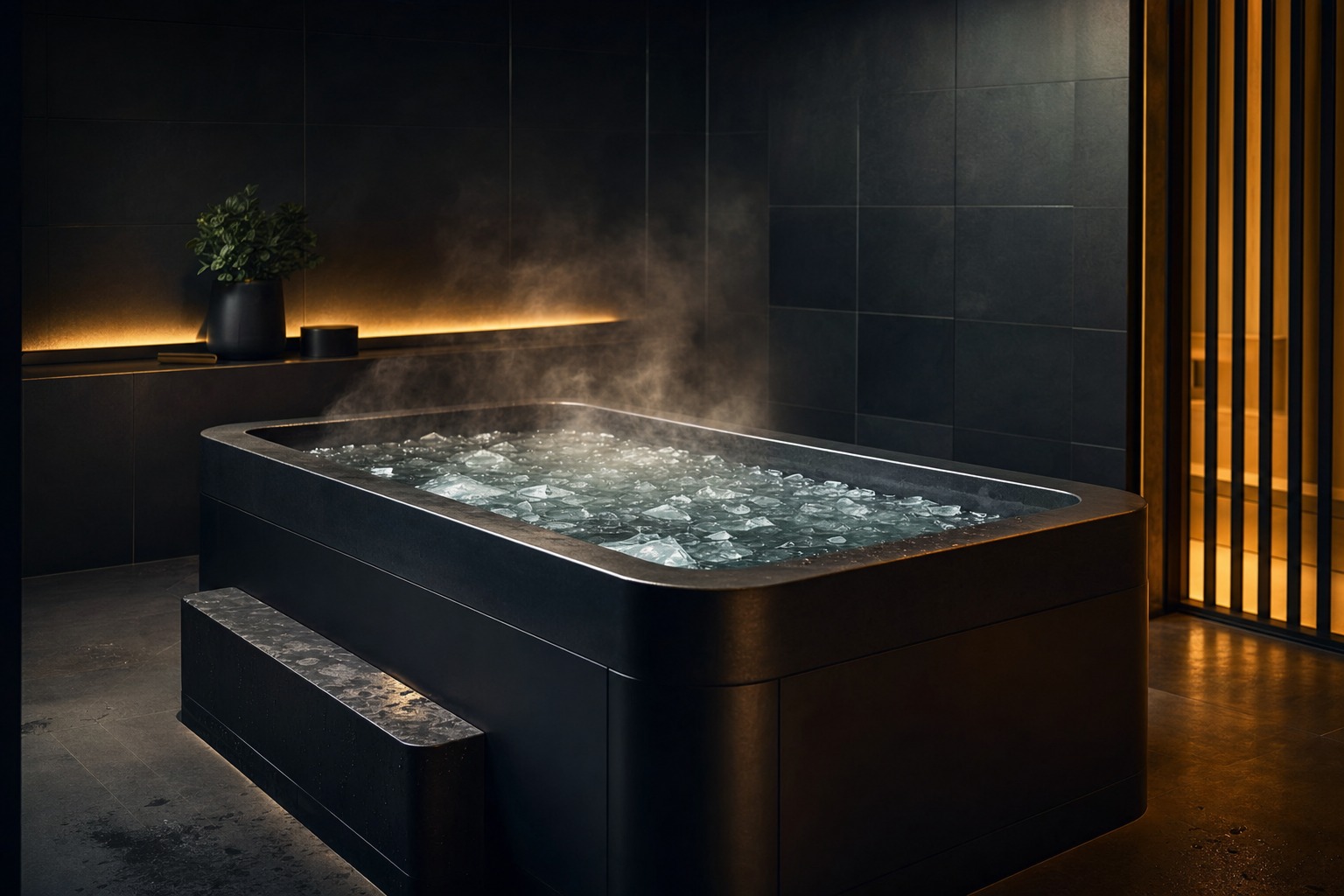
The mechanism that matters is water temperature at the skin, sustained long enough to trigger a norepinephrine and cold-shock response. A $3,000 chiller-equipped tub is convenient — it holds temperature automatically. But the norepinephrine spike doesn't know or care whether the cold came from a compressor or a bag of ice. What matters is hitting 50–59°F for general use, or down to 39–45°F for more aggressive protocols, and holding it for the duration of your session.

Sauna: Core Temperature Elevation, Not Cabin Size

Heat therapy benefits — heat shock protein production, cardiovascular conditioning, sweat rate, subjective relaxation — are driven by raising core body temperature and sustaining it, typically for 20–45 minutes. A full cabin does this by heating ambient air, which then heats you. A sauna blanket skips that step and heats you directly, which is actually more thermally efficient per dollar and per minute. The number to look for is operating temperature range (most quality blankets run 122–170°F / 50–77°C) and whether the heating layer is carbon fiber (even, consistent heat) versus cheaper nichrome wire elements (uneven hot spots).

Red Light Therapy: Irradiance at Distance, Not Wattage Claims

This is where budget shoppers get misled most often. Total wattage and LED count are marketing numbers — they tell you almost nothing about dose delivered to your skin. What matters is irradiance (mW/cm²) measured at your actual treatment distance, typically 6 inches. Look for panels that publish third-party-verified irradiance data at 6 inches, not just at "0 inches" (which inflates the number and isn't a distance anyone actually uses). You also want real 660nm (red) and 850nm (near-infrared) wavelengths — cheap panels often substitute 630nm or 810nm diodes, which are less studied and less effective for penetration depth.

Cold Plunge Budget Picks

For cheap cold plunge options, you have three real paths: inflatable portable tubs, stock tanks (DIY), and hard-sided budget tubs. Here's how they compare.

Inflatable Portable Tubs — Best for Most Beginners

A quality inflatable cold plunge tub is the lowest-friction way to start. No chiller, but the insulated wall models hold ice-chilled water cold enough for a 10–15 minute session, and they pack down to fit in a closet between uses. This is the entry point we recommend for anyone who hasn't committed to cold exposure as a long-term habit yet — validate that you'll actually use it before spending four figures on a chiller-equipped tub.

Budget pick — Cold Plunge

Budget Cold Plunge Portable Tub — ~$179

Insulated inflatable walls, holds 100+ gallons, packs down for storage. No chiller — use ice — but gets you into a legitimate cold immersion protocol for a fraction of a hard-sided tub's price.

Check Price on Cold Tub

DIY Stock Tank — Cheapest Path, More Labor

A galvanized stock tank from a farm supply store ($90–$150 for a 100-gallon unit) is the cheapest way into cold immersion, full stop. The tradeoffs: no insulation, no filtration, and you'll be dumping and refilling water manually every few sessions unless you add a simple pond pump and filter. If you're handy and want to spend the absolute minimum, this works — but factor in the time cost, which is real.

What Temperature You Actually Need

You do not need 39°F. Most of the research on cold water immersion benefits — reduced muscle soreness, mood elevation via norepinephrine, improved sleep in some studies — is documented in the 50–59°F (10–15°C) range for sessions of 5–15 minutes. That range is easily achievable with a well-insulated inflatable tub, a garden hose, and 2–3 bags of store-bought ice. Save the sub-45°F protocols for later, once you're a season into consistent practice.

Sauna Budget Picks: Blankets vs. Portable Saunas

This is the highest-value category in the entire stack. For an affordable infrared sauna blanket, you're getting genuine heat therapy at 10–15% of the cost of a cabin.

Sauna Blankets — Best Value in the Entire Stack

A sauna blanket wraps around your body on a table or bed and heats you directly via carbon fiber elements. Setup takes under a minute, cleanup is wiping it down, and storage is a fraction of a portable tent sauna. Per dollar of core-temperature elevation delivered, nothing beats this category.

⭐ Best Value — Sauna

Higher Dose Sauna Blanket — ~$399

Carbon fiber heating elements for even heat distribution, temperature range up to 170°F, and a proven track record as the category leader in direct-to-consumer sauna blankets. This is the single highest ROI item in the entire $499 stack.

View Higher Dose Sauna Blanket

Portable Tent Saunas — More Space, More Hassle

Portable pop-up tent saunas (you sit inside with your head out, or fully enclosed with a chair) run $150–$350 and heat ambient air rather than your body directly. They take longer to reach effective temperature, are less efficient with electricity, and take up considerably more storage space than a blanket. The one advantage: if you dislike the feeling of being wrapped tightly, a tent sauna gives you room to move. For most people optimizing for value and consistency, the blanket wins.

Feature Sauna Blanket Portable Tent Sauna
Typical price $150–$400 $150–$350
Time to effective heat 5–10 minutes 15–20 minutes
Storage footprint Folds flat, closet shelf Requires floor space
Electricity cost per session Lower (direct body heating) Higher (heats air volume)
Best for Most people, small spaces Those who dislike wraps

Red Light Therapy Budget Picks

A budget red light therapy panel can absolutely deliver real photobiomodulation — but this category has the widest gap between good and useless products at the low end.

What Irradiance Specs Actually Matter

What to Avoid at This Price Point

Skip any panel that markets itself purely on wattage ("500W panel!") without publishing irradiance data at a stated distance. Skip panels using 630nm/810nm diodes marketed as equivalent to 660nm/850nm — they are not interchangeable, and the wavelength difference affects how deep the light penetrates tissue. And skip generic unbranded panels from marketplaces with no manufacturer support or warranty; red light panels have LED arrays that degrade, and a 1-year minimum warranty is a reasonable baseline expectation even in the budget tier.

Best Value — Red Light

NovaaLab Red Light Panel — ~$199

Dual-wavelength 660nm/850nm output with published irradiance data at 6 inches. Compact enough for targeted sessions (face, joints, localized soreness) while staying well within the sub-$500 stack budget.

View NovaaLab Panel

Step-Up Option: Mito Red Light MitoADAPT

If you can flex your red light budget up slightly, the Mito Red Light MitoADAPT is worth the difference. It offers stronger irradiance at range and broader coverage than most sub-$200 panels, making it a better fit if red light is the component you'll use most or if you want to treat larger areas (back, full leg) in a single session.

Step-up pick — Red Light

Mito Red Light MitoADAPT — ~$299

Higher irradiance at distance and larger coverage area than entry-level panels. Best if red light therapy is your primary focus within the stack, or you're treating larger muscle groups.

View Mito Red Light MitoADAPT

The Complete $499 Stack

Here's the full cold plunge sauna red light therapy under $500 build, prioritizing the highest-value product in each category:

Component Product Price
Cold Plunge Budget Cold Plunge Portable Tub ~$179
Sauna Higher Dose Sauna Blanket ~$399*
Red Light NovaaLab Red Light Panel ~$199*

*Sauna blanket and red light brands frequently run promotional pricing and bundle discounts — actual stack total commonly lands closer to $479–$499 with an active promo code applied. Check current pricing at checkout.

This build covers all three mechanisms — cold shock response, sustained core heat elevation, and photobiomodulation — using products that are actively good in their category, not just the cheapest thing available. It's the stack we'd recommend to someone who's done their homework and is ready to commit to a real weekly protocol.

Alternative all-in-one option

RecoverEx — Multi-Modality Bundle

If you'd rather buy from a single brand than assemble a stack piece by piece, RecoverEx offers bundled recovery packages that can slot into a sub-$500 budget depending on configuration. Worth comparing against the à la carte stack above before you buy.

View RecoverEx Bundles

The $300 Ultra-Budget Stack for Total Beginners

If $499 is still more than you want to commit before you know whether you'll stick with a recovery routine, here's a leaner build that still covers all three modalities:

Total: roughly $300, sometimes less depending on promotions. The tradeoffs versus the $499 stack: smaller cold plunge capacity, less consistent sauna heat distribution if you go with a lower-tier blanket, and a red light panel suited to spot-treatment rather than larger body areas. For a beginner testing whether this protocol fits their life, that's a completely reasonable set of tradeoffs.

What to Buy First If You Can Only Afford One Thing

Buy the sauna blanket first. Here's the reasoning: it has the lowest barrier to actually using it — no ice logistics, no water to drain, no need for outdoor or garage space. Heat therapy compliance rates in casual users tend to be higher than cold plunge compliance, simply because there's less friction between "I want to do this" and "I'm doing it." A $399 sauna blanket you use four times a week beats a $500 stack where the cold plunge tub sits in the garage half-inflated after week three.

Once the sauna habit is established — typically 3–4 weeks of consistent use — add the cold plunge, since by that point you have a proven track record of showing up for recovery work. Add red light last; it's the most passive of the three modalities (you can do it while reading or on a call) and the easiest to slot in once the other two habits are locked in.

The Bottom Line

You do not need $5,000 to run a real recovery protocol. A $499 stack built from a portable cold plunge tub, the Higher Dose Sauna Blanket, and a NovaaLab red light panel covers all three core mechanisms — cold shock, sustained heat, and photobiomodulation — at a fraction of the premium-tier cost. If you're not ready for that full commitment, the $300 ultra-budget version still gets you a legitimate starting protocol. Either way, start with the sauna blanket if you can only buy one thing — consistency beats equipment quality every time.

Subscribe for more

Get The Recovery Dispatch — Free

Weekly protocol notes, exclusive discount codes, and new guide alerts. 3,400+ subscribers.

Join the Newsletter

FAQ

Can you really build a full recovery stack for under $500?

Yes. A portable inflatable cold plunge tub, an infrared sauna blanket, and a compact red light panel can be assembled for roughly $479–$499 total in 2026. You give up some conveniences a $5,000+ setup offers — no built-in chiller, less sauna coverage, lower irradiance at range — but the core physiological mechanisms (cold shock response, elevated core temperature, photobiomodulation) are all present at meaningful, evidence-supported doses.

What's the single best budget recovery purchase to start with?

A sauna blanket. It delivers heat exposure benefits (cardiovascular conditioning, heat shock proteins, sweat-based detox, relaxation) with the lowest cost of entry, the least maintenance, and zero water or ice logistics. It also stores flat in a closet. Most beginners get more consistent use out of a sauna blanket than a cold plunge tub, simply because the barrier to starting a session is lower.

Are budget red light therapy panels actually effective, or a waste of money?

Effectiveness depends entirely on irradiance at your actual treatment distance, not marketing claims about wattage or LED count. A budget panel delivering at least 30–50 mW/cm² at 6 inches, with real 660nm red and 850nm near-infrared wavelengths (not cheap 630nm/810nm substitutes), can produce real photobiomodulation effects. Avoid panels that don't publish independently verified irradiance data — that omission is the biggest red flag in the budget tier.

Do I need ice for a budget inflatable cold plunge tub?

In most climates, yes, at least seasonally. Inflatable tubs without a chiller will settle near ambient groundwater or tap temperature, which is often 55–70°F depending on season and location — not cold enough for a strong norepinephrine response. Adding 2–3 bags of ice gets a 100-gallon tub into the 45–55°F range for 20–30 minutes, which is sufficient for most documented cold immersion protocols.